

Class Time
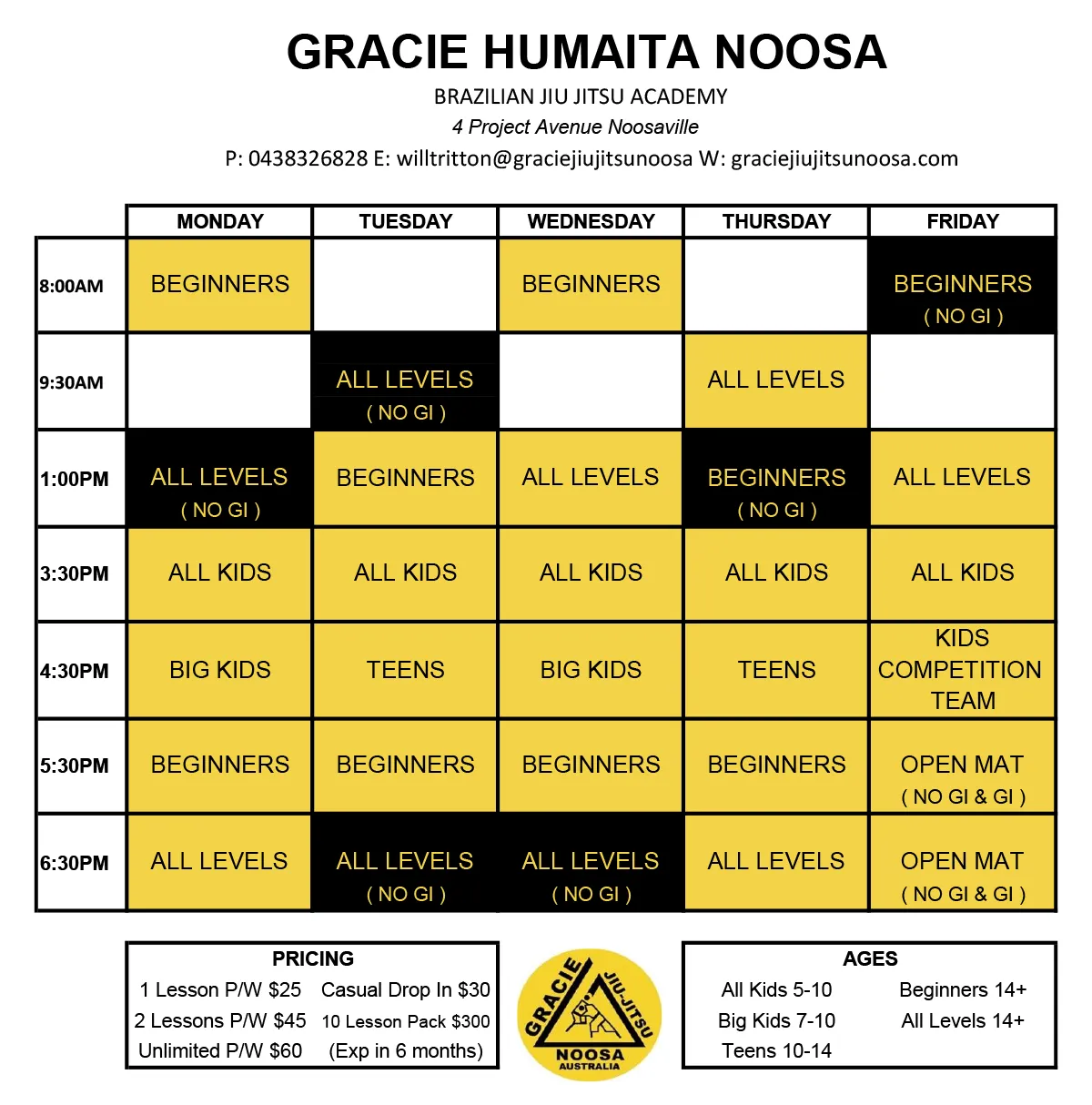
Big Kids Jiu Jitsu
This program is designed for students aged 7 –10 years who are new to Brazilian Jiu Jitsu.
Each class follows a structured format within a rotating curriculum. In every session, students learn about the history, language, manners, and key figures of Jiu Jitsu. They also develop safe falling skills from both stationary and dynamic positions.
The technical requirements for their next belt are taught by Professor Monika (aka Combat Wombat) and Professor Will together in every class, ensuring consistent instruction and attention to detail.
Supervised sparring is included in every session. This allows students to explore their developing abilities while receiving constructive feedback when techniques are mistimed, incomplete, or require refinement.
Games are strategically integrated throughout the class to build attention, creativity, body awareness, and social skills.
Every 2–3 weeks, the class structure shifts to include themed sessions such as Obstacle Course Week, Sumo Week, and Open Mat Week (matches only). These variations keep engagement high while reinforcing core skills.
The Big Kids Jiu Jitsu program includes technical detail, students at this age are able to understand and apply more refined concepts. The class has a very strong retention rate, as students tend to fall in love with the different aspects of Jiu Jitsu — including creating training playlists, building friendships with students from different ages and schools, and being part of a positive, structured environment.
As students mature, they are encouraged to transition into the Big Kids and then Teens classes to continue being challenged technically and to be treated with greater independence and maturity — particularly as many are also moving into high school. When considering a student’s transition to the next class, we take into account not only their age, but also their size, maturity, athletic capability, level of interest, and drive to understand Jiu Jitsu more deeply.
The nurturing approach of the instructors, combined with their passion for teaching, creates a space where students continue to grow both on and off the mats.
All Kids Jiu Jitsu
This class is open to students aged 5–10 years and is often attended by siblings of different ages.
Having a broader age range in this class is unique compared to our other programs, which typically have an age spread of approximately four years. This creates a dynamic training environment where younger students can look up to older peers, and older students can develop leadership and mentoring qualities.
The All Kids classes blend foundational learning with more detailed technical development.
Each session follows a structured format within a rotating curriculum. In every class, students learn about the history, language, manners, and key figures of Jiu Jitsu. They also develop safe falling skills from both stationary and dynamic positions.
The technical requirements for their next belt are taught by Professor Monika (aka Combat Wombat) and Professor Will together in every class, ensuring consistency and high-quality instruction.
Supervised sparring is included in every session. This allows students to explore their developing abilities while receiving constructive feedback when techniques are mistimed, incomplete, or require refinement.
Games are strategically integrated throughout the class to build attention, creativity, body awareness, and social skills.
Every 2–3 weeks, the class structure shifts to include themed sessions such as Obstacle Course Week, Sumo Week, and Open Mat Week (matches only). These variations keep engagement high while reinforcing core skills.
Teens Jiu Jitsu
This class is best suited to students in the early double digits through to 14 years of age. Many teenagers also cross-train in both the Teens and Adult classes as they mature and develop technically. This progression is encouraged, with the goal of transitioning students into the Adult classes when they are ready — particularly if they are no longer sufficiently challenged, have outgrown the other teens physically or technically, and to ensure the training environment remains safe. Teenagers develop at different levels of athleticism, coordination, strength, and intent, and this is carefully considered within the class structure.
The teaching style and class structure differ from the Little and Big Kids programs. The curriculum is a hybrid of the Kids Syllabus and the Adult Syllabus, with the long-term goal of students being capable and eligible to grade to Blue Belt once they reach 16 years of age and have spent sufficient time training in the Adult classes alongside both Adults and Teens.
Each session follows a structured format within a rotating curriculum. Students continue developing safe falling skills from both stationary and dynamic positions. Social connection is an important part of being a teenager, and positive social interaction is encouraged within the class environment.
The technical requirements for their next belt are taught by Professor Monika (aka Combat Wombat) and Professor Will together in every class, ensuring consistency, clarity, and strong technical foundations.
Supervised sparring is included in every session. This allows students to test their abilities in a controlled environment while receiving detailed feedback when techniques are mistimed, incomplete, or require refinemen
Every 2–3 weeks, the class structure shifts to include themed sessions such as Obstacle Course Week, Sumo Week, and Open Mat Week (matches only). These variations keep engagement high while reinforcing core skills.
When considering a student’s progression into the Adult classes, we take into account not only their age, but also their size, maturity, athletic capability, level of interest, and drive to understand Jiu Jitsu more deeply.
Historically, this has been one of our most popular classes. Students develop a strong sense of community, respect, friendship, and detail-focused Jiu Jitsu. Being a teenager can be challenging, and Professor Monika and Professor Will are committed to creating a fun, positive, and open environment where students can learn about themselves through the process of training Jiu Jitsu.
Adult Beginner Jiu Jitsu
This class is designed for mature teens and adults alike.
Each session begins with a basic solo, partner, or line drill to develop the movement patterns that will be used in the techniques taught that day.
A self-defence technique is then introduced and repeated throughout the week to build understanding, reflexes, and awareness of variations.
Jiu Jitsu is built around positions. A match is a series of exchanges within these positions between you and your training partner. If you successfully execute an offensive technique from your current position, you progress to a more dominant position. If your partner executes their offence, you may move into a less dominant position.
In the Beginners classes, we study a Module for 12 Weeks, 4 Modules a year. Every week in a Module we change positions but use the same tools to deal with the position and/or problem. Students learn one defensive or offensive technique from that position each week, allowing time to understand both the individual technique, variations, expected reactions from their opponent and the overall structure of the position. This builds over 12 Weeks and builds the Module.
The final section of the class is Positional Sparring. This is a structured version of sparring where only a specific position is contested between students. In a full match, any position can occur, which can sometimes lead beginners into frustration, unfamiliar situations, or increased risk of injury. Positional Sparring is essential for all belts, but especially important for beginners, as it provides clarity. Students know the starting position, understand the goals, and have a clear reset point.
Typically, students complete a two-minute positional round followed by a brief 10-second reset to swap roles. This is repeated multiple times, often for eight rounds.
Higher belts also attend this class to refresh their knowledge when certain positions appear in the curriculum, to refine details within their strongest positions, or to participate in positional sparring with other coloured belts.
All Levels Jiu Jitsu
This class is designed for students of all experience levels, from Beginners to Experts in Brazilian Jiu Jitsu. The main difference between this class and the Beginners class is that halfway through each session, there are 30 minutes of live matches.
These matches are typically structured as five-minute rounds with a two-minute rest period between rounds for feedback and recovery. This is usually repeated four to five times. Due to this match component, there is approximately 10–15 minutes less technical instruction compared to the Beginners class.
Each session begins with a basic solo, partner, or line drill to develop the movement patterns that will be used in the techniques taught that day.
A self-defence technique is then introduced and repeated throughout the week to build understanding, reflexes, and awareness of variations.
In the All Levels classes, we study a Module for 12 Weeks, 4 Modules a year. This is a parallel syllabus to the Beginners Modules. Every week in a Module we change positions but use the same tools to deal with the position and/or problem. Students learn one defensive or offensive technique from that position each week, allowing time to understand both the individual technique, variations, expected reactions from their opponent and the overall structure of the position. This builds over 12 Weeks and builds the Module.
Private Lessons
We offer private lessons for individuals or small groups. The cost varies depending on what the student or group would like to focus on and develop.
Private sessions are tailored to specific goals, whether that be technical refinement, competition preparation, self-defence, confidence building, or accelerated progression.
Please contact us directly to discuss your goals and receive further information.